
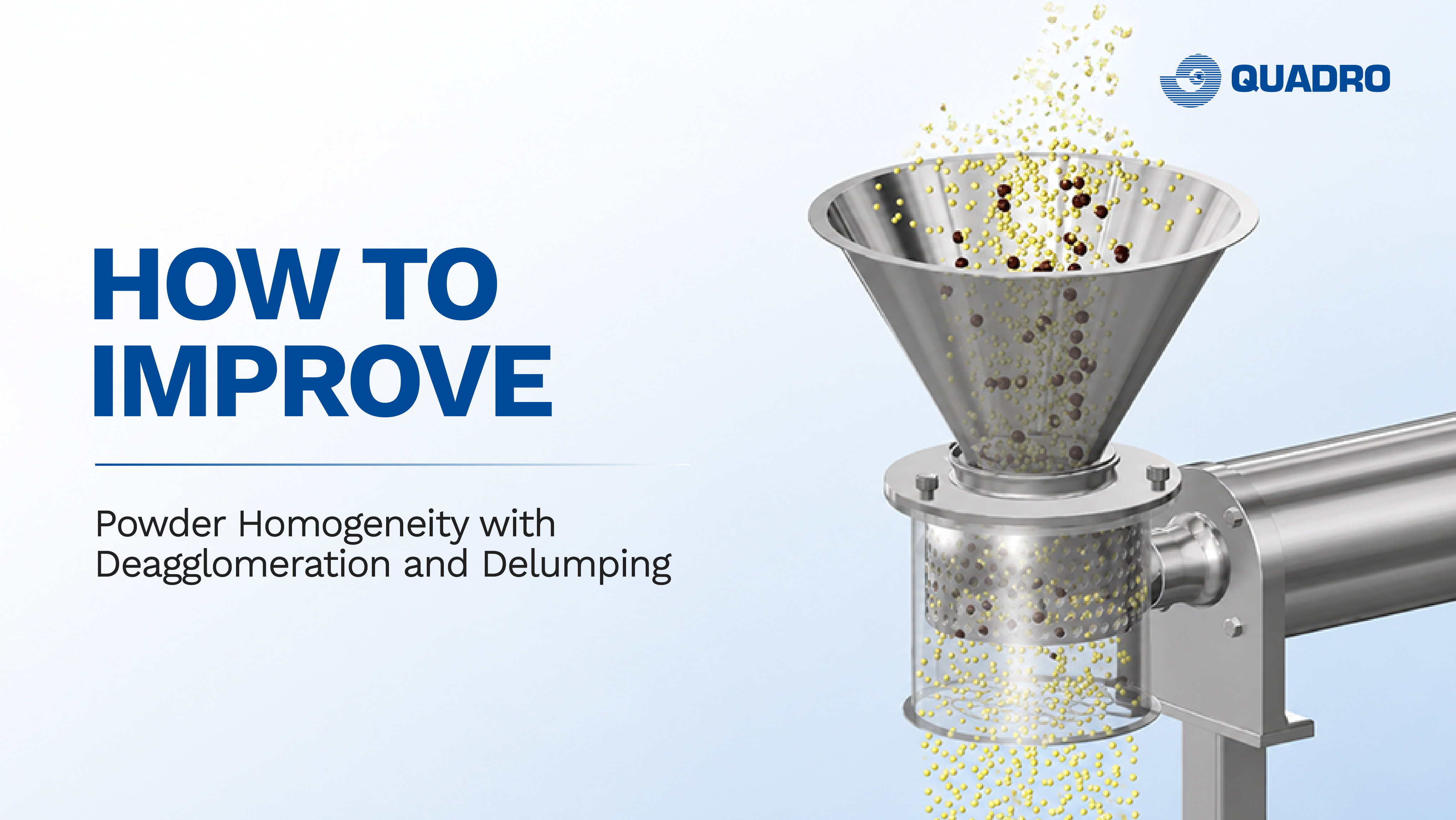
Powder homogeneity depends on how evenly particles and ingredients are distributed before they enter key production stages such as blending, filling, compression, or packaging. When powders contain lumps or soft agglomerates, they do not flow, mix, or dose consistently. Powder deagglomeration and powder delumping improve homogeneity by breaking these clusters into a more uniform distribution, helping manufacturers reduce segregation, improve batch consistency, prevent equipment blockages, and protect final product quality.
In production environments, this is achieved using controlled delumping, screening, or milling systems that apply the right level of mechanical action without damaging sensitive ingredients.
What Is Powder Deagglomeration?
Powder deagglomeration is the process of breaking apart clusters of particles that have formed during handling, storage, drying, transfer, or processing. These clusters are usually not hard particles. They are loose or soft agglomerates that need to be separated so the powder can return closer to its intended form.
Agglomerates may form because of:
- Moisture exposure
- Static charge
- Fat or oil content
- Heat-sensitive ingredients
- Compression during storage
- Poor flow during transfer
- Long holding times in bags, bins, or containers
The goal of deagglomeration is not always particle size reduction. In many cases, the aim is to restore flowability and improve powder uniformity without damaging the ingredient.
What Is Powder Delumping?
Powder delumping focuses on breaking larger lumps into smaller, more processable material. Lumps may form when powders compact during storage, absorb moisture, or settle under their own weight.
Why Does Powder Homogeneity Matter?
Powder homogeneity means the ingredients are evenly distributed across the batch. Inconsistent powder distribution can affect product quality, process efficiency, and final performance.
Poor homogeneity can lead to:
- Uneven ingredient distribution
- Poor flow into hoppers, feeders, or tablet presses
- Inconsistent fill weights
- Tablet weight variation
- Poor dissolution or compaction
- Product segregation
- Blockages in the downstream equipment
- Higher rejection or rework rates
For food and pharma manufacturers, this matters because every batch must meet quality, safety, and consistency expectations.
How to Improve Powder Homogeneity with Deagglomeration
The best way to improve powder homogeneity with deagglomeration is to condition the powder before it enters critical downstream steps.
1. Break Lumps Before Blending
If lumpy powders enter the blender, the final mix may look blended but still contain uneven ingredient pockets. Delumping before blending helps each ingredient distribute more evenly.
This is especially useful for powdered flavours, dairy powders, nutraceutical blends, APIs, excipients, and chemical ingredients.
2. Remove Agglomerates Without Damaging Particles
Some products need gentle handling. Food inclusions, active ingredients, and heat-sensitive powders may lose quality if processed too aggressively. Gentle deagglomeration helps separate particles while preserving product integrity.
3. Control Particle Distribution Before Downstream Processing
Powder delumping for uniform particle distribution helps create a more predictable feed into equipment such as mills, mixers, tablet presses, capsule fillers, packaging lines, and transfer systems.
A consistent feed improves process control and reduces the risk of flow interruptions.
4. Match Equipment to the Material
Not every powder needs the same level of processing. Some materials need light screening. Others need controlled delumping or conical milling. The right approach depends on powder behaviour, target particle size, fragility, moisture sensitivity, and throughput requirements.
Where Is Deagglomeration and Delumping Used?
Deagglomeration and delumping for powders is used across many industries where consistent powder behaviour is important.
Food Manufacturing
Food powders often contain ingredients that are hygroscopic, fatty, sticky, or sensitive to heat. These powders may form lumps during storage or transfer. Deagglomeration helps improve flow, mixing, texture, and packaging consistency.
Common examples include:
- Dairy powders
- Protein powders
- Spices and seasonings
- Drink mixes
- Bakery ingredients
- Nutritional blends
- Dried fruit and inclusions
Pharmaceutical Manufacturing
In pharma, powder uniformity affects blend consistency, tablet compression, capsule filling, dosage accuracy, and downstream performance. APIs and excipients must be correctly conditioned before granulation, blending, or compression.
Nutraceuticals
Nutraceutical powders often combine vitamins, minerals, proteins, botanicals, and active compounds. Delumping helps support better ingredient distribution and dose consistency in tablets, capsules, sachets, and drink powders.
Chemical Processing
Chemical powders may require delumping before packaging, blending, dispersion, or reaction steps. Uniform powder flow helps reduce batch variation and improves process reliability.
Why Does This Matter for Process Efficiency?
When powders are properly deagglomerated and delumped, they move more predictably through production. This can:
- Reduce stoppages
- Improve blending
- Support accurate filling
- Reduce cleaning frequency
- Improve batch-to-batch consistency
For manufacturers, better powder conditioning means fewer process interruptions and more reliable final product quality.
Conclusion
Powder deagglomeration and powder delumping play a key role in achieving consistent powder homogeneity by eliminating lumps and ensuring even particle distribution ahead of critical processing stages. Selecting the appropriate powder processing equipment enables manufacturers across the food, pharmaceutical, nutraceutical, and chemical industries to enhance flowability, improve blending accuracy, and maintain reliable product quality. To take the next step toward more controlled and efficient powder handling, explore Quadro’s range of delumping, screening, and conical milling solutions or connect with our team to identify the best fit for your application.