
Modern pharmaceutical and biotechnology manufacturing increasingly depends on technologies that can deliver consistent particle size reduction. Stable formulations. Reliable processing outcomes.
As drug delivery systems evolve toward nanotechnology-driven formulations and biologics. Manufacturers require processing systems capable of achieving precise control over particle size distribution. And product uniformity.
One technology that plays a central role in these advanced applications is the High Pressure Homogenizer. This equipment is widely used across pharmaceutical formulation development. Biotechnology research. Advanced material processing.
Its ability to create extremely fine emulsions. Disrupt biological cells. Reduce particle size. Makes it indispensable in modern manufacturing environments.
The increasing demand for advanced drug delivery systems has further elevated the importance of nanoemulsions technology. Nanoemulsions enable enhanced bioavailability. Targeted drug delivery. Improved product stability.
Producing these systems requires high shear processing capable of generating uniform nanometer-scale droplets.
At the same time. The biotechnology industry depends heavily on efficient cell disruption machine technologies. Cell disruption processes are essential for extracting valuable intracellular components. Such as proteins. Enzymes. Nucleic acids.
These components are widely used in vaccine development. Therapeutic proteins. Gene therapy.
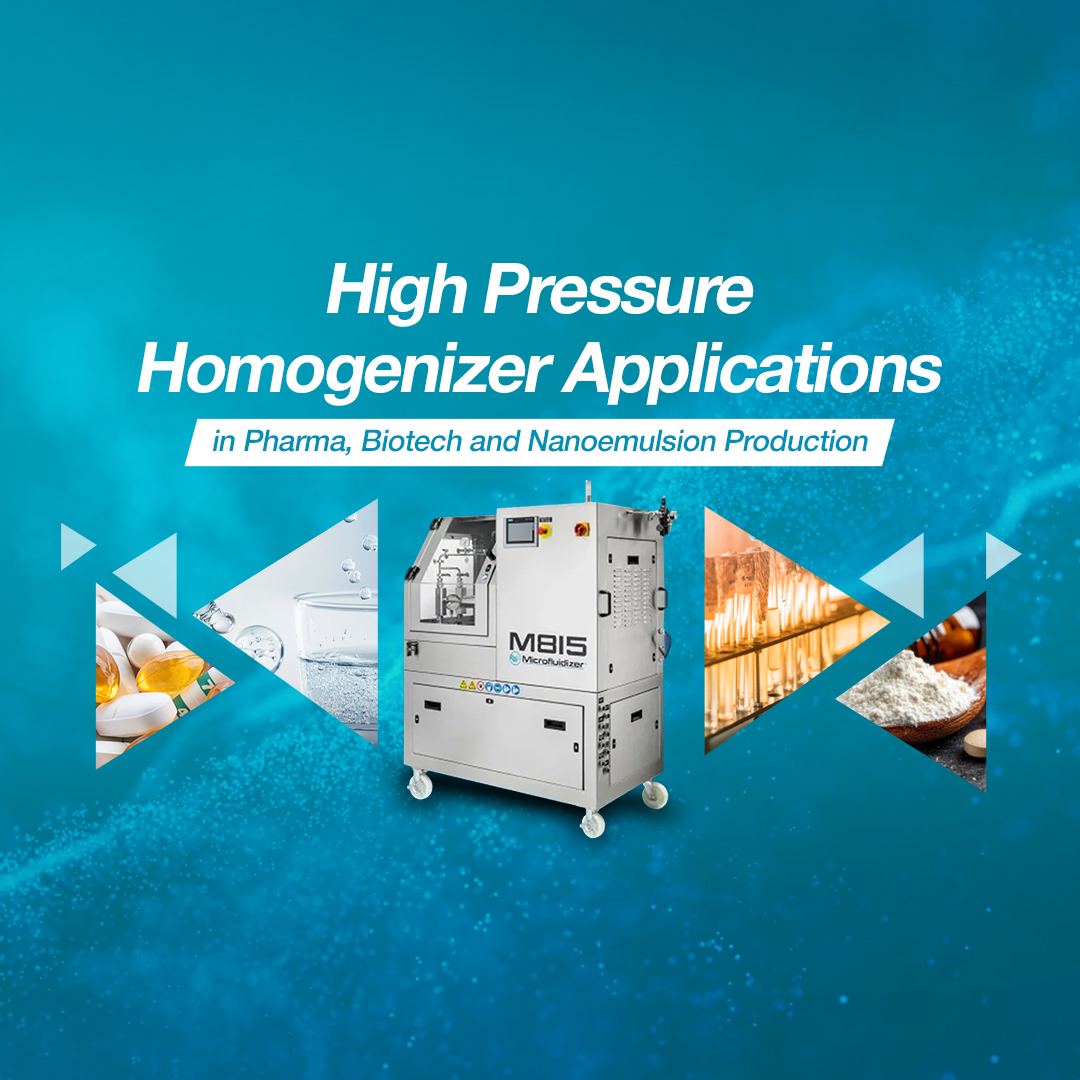
High-performance homogenization systems such as Microfluidizer® processors have emerged as reliable solutions for these complex processing needs. These systems convert fluid pressure into controlled shear forces. Producing uniform particle size reduction. Repeatable processing outcomes.
This article explores how the High Pressure Homogenizer works. Its role in nanoemulsions technology. And its applications as a cell disruption machine across pharmaceutical and biotechnology industries.
Understanding High Pressure Homogenizer
A High Pressure Homogenizer is a processing device designed to reduce particle size. And create highly uniform dispersions. This is achieved by applying extremely high pressure and shear forces to fluid materials.
In this system. A liquid formulation is forced through a narrow interaction chamber. Pressures may reach up to 30,000 PSI.
The sudden pressure drop. Combined with shear. Impact. Cavitation effects. Breaks down particles and droplets into nanoscale dimensions.
The ability of the High Pressure Homogenizer to maintain constant pressure. And deliver uniform processing conditions. Ensures that every portion of the product experiences the same shear treatment.
This consistency is essential for producing stable formulations. With predictable performance.
Advanced Microfluidizer® processors are widely recognized for their ability to achieve superior results in applications such as nanoencapsulation. Nanoparticle production. Emulsification. Cell disruption.
In pharmaceutical production environments. The High Pressure Homogenizer is valued for its ability to generate extremely small droplet sizes. While maintaining tight particle size distributions.These capabilities are critical when producing nanoscale drug delivery systems.
Operating Principle of High Pressure Homogenizer
The effectiveness of a High Pressure Homogenizer lies in its ability to convert hydraulic pressure into controlled shear energy.
This energy acts on particles and droplets in the fluid. Breaking them down into smaller sizes.
High Pressure Pumping
The process begins when the fluid mixture is pressurized using a powerful pumping system.The fluid is pushed through the system at extremely high pressures. Often exceeding several thousand PSI.
This stage provides the driving force required to push the fluid through the homogenization chamber.
Interaction Chamber Processing
The pressurized fluid then enters a specialized interaction chamber. Here it experiences intense shear forces.
In Microfluidizer® systems. A fixed-geometry interaction chamber ensures that all material passing through the system experiences identical processing conditions.
The interaction chamber generates multiple processing forces.
- Shear forces
- Impact forces
- Turbulence
- Cavitation
These forces break down particles and droplets into nanoscale structures.
Uniform Processing
A major advantage of the High Pressure Homogenizer is its ability to process the entire product uniformly.Every milliliter of fluid receives the same shear exposure. Ensuring consistent results regardless of batch size.
This uniform treatment is essential for industries where product quality. Repeatability. Regulatory compliance. Are critical.Role of Nanoemulsions Technology in Pharmaceutical Formulations
Nanoemulsions technology is rapidly gaining importance in pharmaceutical development.Nanoemulsions are emulsified systems with droplet sizes typically ranging between 20 and 200 nanometers.
Such extremely small droplet sizes provide several advantages for pharmaceutical products.
Improved Bioavailability
Many pharmaceutical compounds have poor water solubility.By using nanoemulsions technology. Drug molecules can be dispersed in nano-sized droplets. This significantly improves absorption. Bioavailability.
Enhanced Drug Stability
Nanoemulsions protect active ingredients from degradation caused by environmental factors. Such as oxidation. Hydrolysis.This improves the stability and shelf life of pharmaceutical products.
Targeted Drug Delivery
Advanced formulations such as liposomes and lipid nanoparticles rely heavily on nanoemulsions technology.These systems deliver drugs directly to targeted tissues or cells.
High shear processing using a High Pressure Homogenizer enables the production of stable nanoemulsions. With uniform droplet size distribution.
Microfluidizer® processors are widely used in the creation of nanoemulsions. Liposomes. Lipid nanoparticles.These technologies have become critical for developing next-generation therapies. Including mRNA vaccines. Targeted drug delivery systems.
High Pressure Homogenizer as a Cell Disruption Machine
In biotechnology manufacturing. Extracting intracellular components from microorganisms is a crucial process.This is where a cell disruption machine becomes essential.
Cells such as bacteria. Yeast. Algae. Mammalian cells. Contain valuable biomolecules inside their cellular structures.To recover these materials. The cell walls must be broken open.Cell Lysis through High Shear Processing
A High Pressure Homogenizer functions as an effective cell disruption machine. By subjecting cells to intense mechanical forces.
As cells pass through the high-pressure interaction chamber. They experience sudden pressure drops. Strong shear forces.These forces rupture the cell membranes. Release intracellular components.
Applications in Biotechnology
Using a cell disruption machine enables the extraction of important biomolecules.
Recombinant proteins
Enzymes
Vaccines
Antigens
DNA and RNA components.
Advanced homogenization systems can process a wide range of cell types. Including bacteria. Yeast, Algae, Mammalian cells.Because the process is mechanical rather than chemical. It allows efficient recovery of proteins. While maintaining biological activity.
Industrial Applications Across Pharma and Biotech
The versatility of the High Pressure Homogenizer supports numerous applications across pharmaceutical. Biotechnology. Nanotechnology industries.
Nanoparticle Production
Modern drug delivery systems rely on nanoparticles to improve therapeutic effectiveness.A High Pressure Homogenizer enables precise particle size reduction required for nanoparticle synthesis.
Liposome Manufacturing
Liposomes are lipid vesicles used to encapsulate drugs. Protect them from degradation.High pressure homogenization ensures consistent liposome size. Stability.
Vaccine Production
In vaccine manufacturing. The cell disruption machine process is used to release antigens from cultured cells.
These antigens form the basis of many vaccine formulations.
Gene Therapy and Biologics
The biotechnology sector relies heavily on cell disruption technologies.
These systems extract viral vectors and genetic materials used in advanced therapies.
Nanoemulsion Drug Delivery
Drug formulations created using nanoemulsions technology enhance the absorption of poorly soluble drugs.
They also enable controlled release mechanisms.
Advantages of High Pressure Homogenizer Technology
Consistent Particle Size Reduction
A High Pressure Homogenizer produces extremely uniform particle sizes.
This improves formulation stability. Ensures predictable product performance.
Excellent Repeatability
Microfluidizer® systems deliver consistent results. With excellent batch-to-batch reproducibility.
This is critical in regulated industries such as pharmaceuticals.
Scalability from Lab to Production
One of the major advantages of modern homogenization systems is their ability to scale seamlessly.From laboratory research. To full industrial production.
Microfluidics technology supports linear scale-up. Allowing manufacturers to replicate laboratory results in commercial manufacturing environments.
Improved Product Yield
Efficient cell disruption machine technology improves protein recovery.It increases extraction efficiency. Improves overall process yield.
IDEX India Microfluidics Solutions
Advanced homogenization systems are increasingly required to support the growing complexity of pharmaceutical and biotechnology manufacturing.
IDEX India offers Microfluidizer® technology designed for applications such as nanoparticle production. Nanoencapsulation. Emulsification. Cell disruption.
These systems convert fluid pressure into precise shear forces. Achieving uniform particle size reduction. Consistent processing outcomes.
Microfluidics processors ensure that every portion of material receives identical processing conditions.
This remains true whether operating at laboratory volumes. Pilot scale. Industrial production.
A notable innovation in this area is the MP350 Microlyser™ processor.
This system is designed specifically for production-scale cell disruption machine applications in biotechnology manufacturing.
The processor incorporates proprietary interaction chamber technology.
It can operate at pressures up to 30,000 PSI. While delivering consistent shear processing.
Such systems support pharmaceutical companies in producing advanced nanomaterials. Biologics. Nanoemulsion formulations. With improved efficiency. Reliability.
Conclusion
The growing demand for advanced pharmaceutical formulations and biotechnology products has created the need for highly precise processing technologies.
The High Pressure Homogenizer has emerged as a critical solution. Achieving uniform particle size reduction. Efficient nanoemulsions technology processing. Reliable cell disruption machine performance.
From producing stable nanoemulsions and nanoparticles. To extracting valuable intracellular biomolecules.
High pressure homogenization plays a central role in modern pharmaceutical and biotech manufacturing.
Technologies such as Microfluidizer® processors provide consistent high-shear processing.They deliver scalable production capabilities. Reliable batch-to-batch repeatability.
As pharmaceutical innovation continues to evolve toward nanotechnology-based drug delivery and biologics manufacturing.The High Pressure Homogenizer will remain a cornerstone technology.
Supporting the development of next-generation therapies. Advanced medical treatments.