
The Impact of Advanced Powder Processing Equipment: The Direct Answer
Deploying targeted powder processing equipment for pharmaceutical manufacturing is the definitive mechanism required to eliminate blend segregation, prevent cross-contamination, and guarantee downstream content uniformity. Unlike manual, open-air material transfers that trigger product loss and operator exposure, specialized pharmaceutical powder processing equipment utilizes closed, cGMP-compliant systems like containment-isolated cone valves and underdriven conical mills. This advanced integration stabilizes material flow dynamics, eliminates structural “rat-holing,” maintains a strict Particle Size Distribution (PSD), and optimizes tablet press and capsule filling speeds, ensuring your continuous production line hits its validation targets at the lowest operational cost.
The Evolution of Powder Processing in the Pharmaceutical Industry
Raw active pharmaceutical ingredients (APIs) and excipients present complex processing challenges. They can be naturally cohesive, static-heavy, moisture-reactive, or highly abrasive. If these materials are subjected to unmonitored handling protocols, factories experience product caking, severe dust generation, and batch non-compliance.
Consequently, powder processing in the pharmaceutical industry has evolved from an uncoordinated sequence of manual operations into a highly synchronized, fully enclosed continuous science. By integrating automated material conditioning directly into the workflow, production suites eliminate human error and stabilize environmental exposures. Modern systems protect fragile molecules from atmospheric humidity and thermal stress while creating a free-flowing, homogenous material matrix that transitions predictably from one processing stage to the next.
Core Applications of Pharmaceutical Powder Processing Equipment
To maintain strict regulatory compliance across Oral Solid Dosage (OSD) and advanced API facilities, engineers utilize targeted powder handling equipment for the pharmaceutical industry across three foundational processing phases:
1. In-Bin Blending and Content Uniformity
When formulating low-dose, high-potency molecules, maintaining absolute recipe uniformity across a 1,000-liter batch is critical. Advanced powder processing systems execute precise blending directly inside sealed Intermediate Bulk Containers (IBCs). This eliminates the product transfer steps required by fixed-shell blenders, preventing dust creation and ensuring minor actives remain perfectly dispersed throughout the carrier matrix.
2. Wet and Dry Granulation Conditioning
Before a formulation can be successfully tableted, raw powder blends must be formed into robust, dense granules. Processing systems safely transport moisture-sensitive formulas through dry roller compactors to establish uniform ribbon density, while wet granulations are directed through low-heat size reduction units to optimize surface areas without thermal degradation.
3. High-Capacity Tablet Press and Capsule Feeding
To prevent defects like tablet capping, weight fluctuations, or uneven die filling, pharmaceutical powder processing equipment for tablets and capsules must feed the downstream machinery continuously. Closed-loop, dust-tight transfer modules ensure that materials enter filling machines under regulated volumetric flows, maximizing compression yields and avoiding machinery clogs.
Key Equipment Configurations: Handling, Blending, and Sifting
Balancing these complex material dynamics requires deploying diverse configurations of powder handling equipment
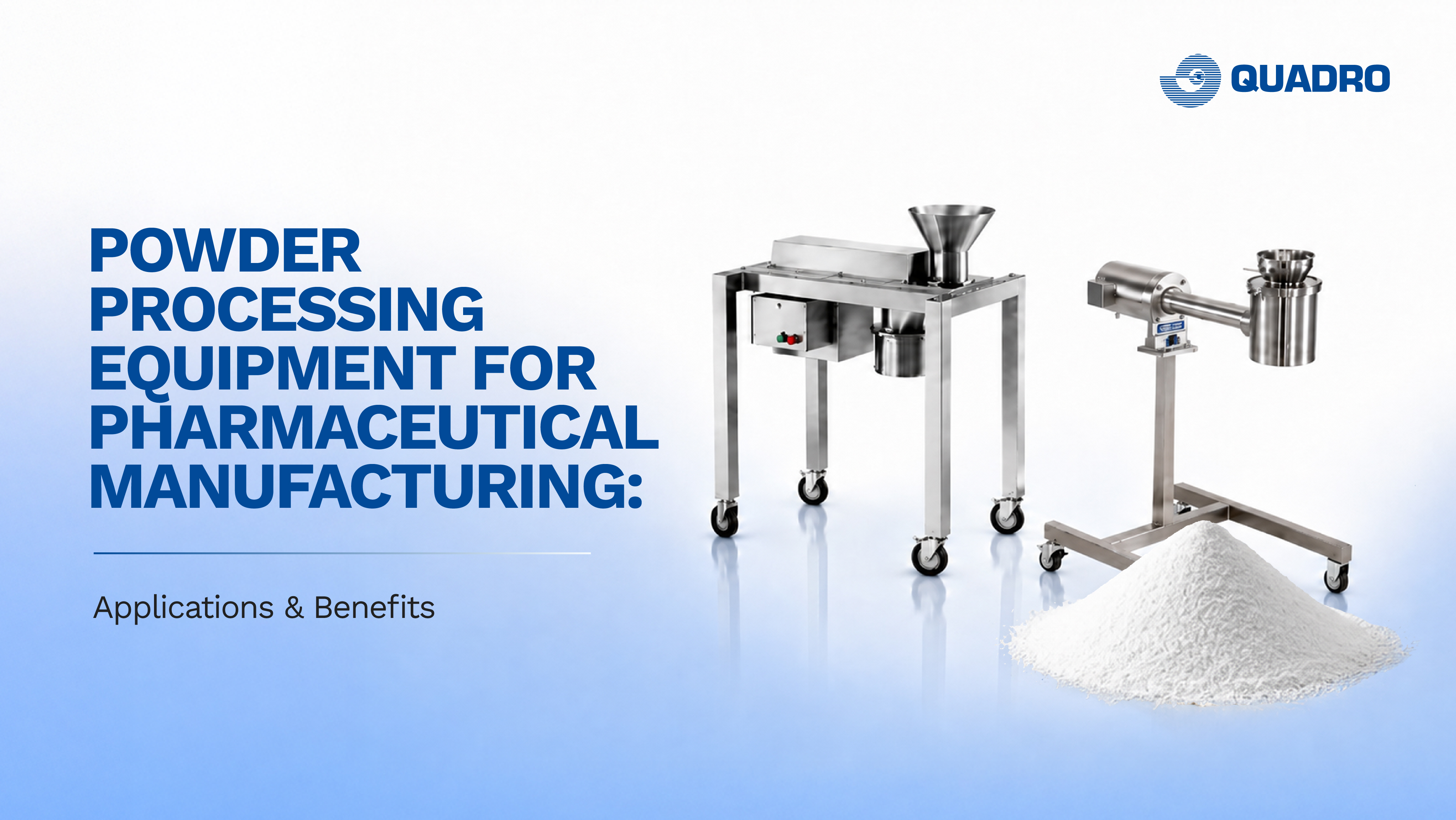
- Underdriven Conical Mills: Space within cleanroom suites is at a premium. Systems like the Quadro® SDx™ U20x move the driving mechanism beneath the milling chamber. This shortens the vertical profile, allowing the unit to fit inline beneath fluid bed dryers or IBC outlets while utilizing centrifugal shear to size wet or dry granules smoothly.
- Cone Valve IBC Systems: Conventional butterfly valve containers allow fine and coarse particles to separate during discharge, causing core flow and localized recipe variations. Matcon’s proprietary Universal Cone Valve (UCV) technology replaces passive gravity drop with active pneumatic lift. This creates an annular opening that forces true mass-flow discharge while entirely preventing rat-holing, bridging, and blend segregation.
- High-Capacity Security Sifters: Positioned at the initial raw ingredient intake area, high-velocity centrifugal riflers like the Flexsift S20 clear packing clumps and eliminate foreign packaging contaminants, safeguarding downstream lines from mechanical damage.
Crucial Benefits of Powder Processing Equipment in Pharma Manufacturing
Implementing automated, closed-loop processing arrays delivers immediate, quantifiable benefits of powder processing equipment in pharma manufacturing environments:
| Process Risk | Consequences of Outdated Handling | Benefit of Advanced Equipment Integration |
| Material Segregation | High-density actives separate from carriers | Active cone valve lift enforces uniform mass flow |
| Dust Contamination | Cross-contamination risks, poor operator hygiene | Hermetically sealed, dust-tight process enclosures |
| Frequent Cleaning Downtime | Hours lost during manual component strip-downs | Wash-in-Place (WIP) and toolless disassembly layouts |
| Thermal Degradation | High friction scorches heat-sensitive APIs | Low-speed centrifugal shear minimizes heat generation |
The Next 10 Years: Future-Proofing for HPAPIs and High-Speed OSD Lines
As global therapeutics pivot toward highly customized, complex, and potent drug structures, manufacturing configurations cannot remain static. Over the next decade, production plants must solve strict high-containment demands. When handling High-Potency Active Pharmaceutical Ingredients (HPAPIs) rated up to OEB 5, open material transfers are entirely unviable.
Future-ready production facilities are addressing these strict processing needs by transitioning from manual batch setups to fully enclosed, continuous-processing paths. By linking automated powder handling nodes with smart-sensor feedback systems, modern production plants track material flow velocities, ribbon densities, and moisture variations in real-time. This eliminates batch-to-batch inconsistencies, satisfies stringent validation protocols, and maximizes product yields without risking workforce exposure.
Conclusion: Connect with IDEX MPT Asia at Pharma Pro&Pack 2026
Optimizing your facility’s solid dosage output requires replacing outdated, unmonitored material transfers with precise, automated material engineering. Selecting the correct powder processing equipment removes execution variables, lowers material waste, and helps your plant maintain complete compliance with global safety regulations.