
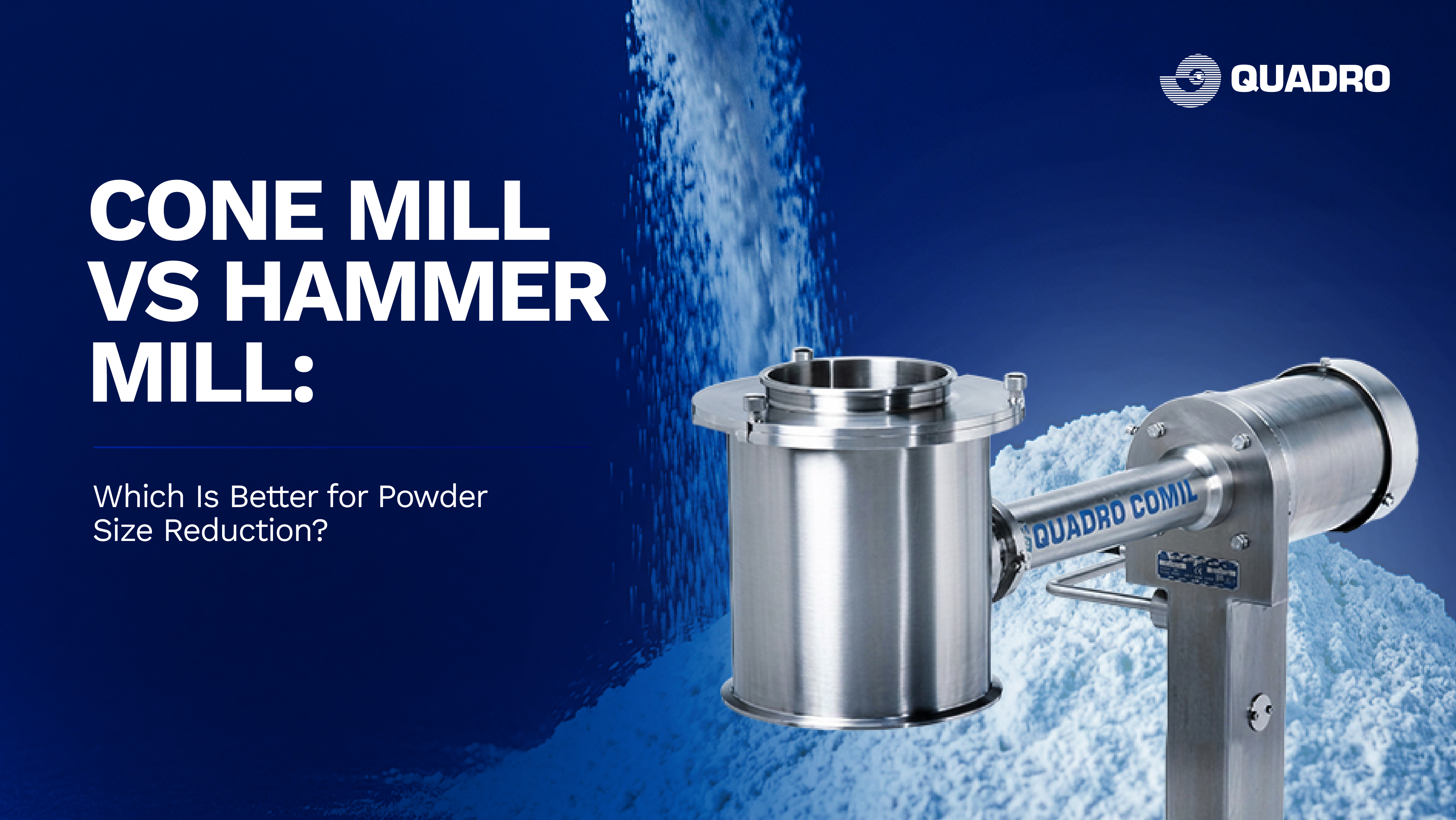
Choosing between a Cone Mill and a Hammer Mill depends on the required particle size, material characteristics, process goals, and industry application. For pharmaceutical powder processing, a cone mill is often preferred when manufacturers need controlled particle size distribution, reduced heat generation, minimal fines, and consistent batch quality.
A hammer mill is better suited for applications requiring aggressive size reduction and higher impact forces. Understanding the difference between a cone mill and a hammer mill helps manufacturers select the right milling equipment for efficient and reliable production.
What Is the Difference Between a Cone Mill and a Hammer Mill?
Both cone mills and hammer mills are used for powder size reduction, but they work differently and deliver different processing outcomes.
A cone mill, also known as a conical sieve mill or Comil, uses a rotating impeller inside a conical screen. Material is gently forced through the screen, allowing manufacturers to achieve a more controlled particle size distribution. This makes cone mills suitable for applications where consistency, product protection, and process repeatability are important.
On the other hand, a hammer mill uses high-speed rotating hammers to break material through impact and shear forces. This approach provides strong size reduction capability and is commonly used for applications where larger particles need to be reduced quickly.
For pharmaceutical applications, the choice depends on whether the priority is controlled sizing and product quality or high-energy size reduction.
How Does a Cone Mill Improve Powder Size Reduction?
A cone mill provides controlled and uniform powder size reduction by combining gentle milling action with precise screen selection.
The key advantages include:
- Better control over particle size distribution
- Reduced generation of unwanted fines
- Lower heat buildup during processing
- Improved batch-to-batch consistency
- Easier integration into pharmaceutical manufacturing lines
These advantages are particularly important in pharmaceutical manufacturing, where particle size affects flow properties, blending uniformity, dissolution rates, and final product quality.
When Should You Use a Hammer Mill for Particle Size Reduction in Pharma?
A hammer mill for particle size reduction in pharma is suitable when the process requires stronger impact-based milling.
Hammer mills are commonly selected for:
- Coarse grinding applications
- Breaking down harder materials
- Processing materials that require higher energy input
- Achieving rapid initial size reduction
However, hammer milling can generate more heat, noise, and fines compared with gentler milling technologies. In pharmaceutical environments, manufacturers must carefully evaluate contamination control, cleaning requirements, and product sensitivity before selecting hammer milling equipment.
For applications requiring tight particle size control and improved product protection, a cone mill is often considered a more suitable solution.
Cone Mill vs Hammer Mill: Which Is Better for Pharmaceutical Powder Processing?
The best mill for pharmaceutical powder processing depends on the material properties and manufacturing objectives.
| Factor | Cone Mill | Hammer Mill |
| Milling action | Controlled cutting and sieving | High-impact size reduction |
| Particle size control | Excellent control and uniformity | Suitable for broader size reduction |
| Heat generation | Lower | Higher due to impact forces |
| Fines generation | Lower | Can be higher |
| Pharmaceutical suitability | Ideal for sensitive products and final sizing | Suitable for aggressive reduction applications |
| Cleaning requirements | Designed for hygienic processing | Depends on the equipment design |
For pharmaceutical manufacturers, where hygiene, containment, batch consistency, and repeatability are critical, cone milling is frequently selected as a reliable solution.
What Factors Should You Consider Before Selecting Milling Equipment?
Selecting the right milling equipment requires evaluating more than just the required particle size.
1. Material Characteristics
Consider:
- Hardness of the material
- Moisture content
- Heat sensitivity
- Flow properties
- Risk of contamination
Sticky or heat-sensitive powders may require gentler processing methods to maintain product integrity.
2. Required Particle Size Distribution
Different applications require different particle sizes. A manufacturer producing tablets may require consistent powder flow and blending characteristics, while another application may require aggressive size reduction.
3. Process Hygiene and Safety
Pharmaceutical manufacturers must prioritise easy cleaning, contamination prevention, and controlled processing environments. Equipment selection should support regulatory requirements and efficient changeovers.
For complete powder handling requirements beyond milling, IDEX India also provides Matcon powder handling solutions designed to address challenges such as segregation, containment, bridging, and powder flow during manufacturing.
How Does Cone Milling Support Efficient Pharmaceutical Manufacturing?
Modern pharmaceutical production requires equipment that supports lifecycle efficiency through reliable operation, easy maintenance, and consistent performance.
Cone milling technology helps improve:
- Powder flow during downstream processing
- Blend uniformity
- Production consistency
- Process efficiency
- Product quality
Our Quadro’s conical milling solutions are designed to support pharmaceutical manufacturers with scalable solutions from laboratory development to production-scale processing.
Final Verdict: Cone Mill or Hammer Mill?
The answer to cone mill vs hammer mill for powder size reduction depends on the application. Hammer mills are effective when high-impact size reduction is required, while cone mills provide better control, consistency, and product protection for many pharmaceutical applications.
For manufacturers looking for reliable milling equipment with controlled particle sizing, reduced product loss, and improved process efficiency, a cone mill is often the preferred choice. Selecting the right technology ensures better powder quality, smoother operations, and long-term manufacturing performance.