
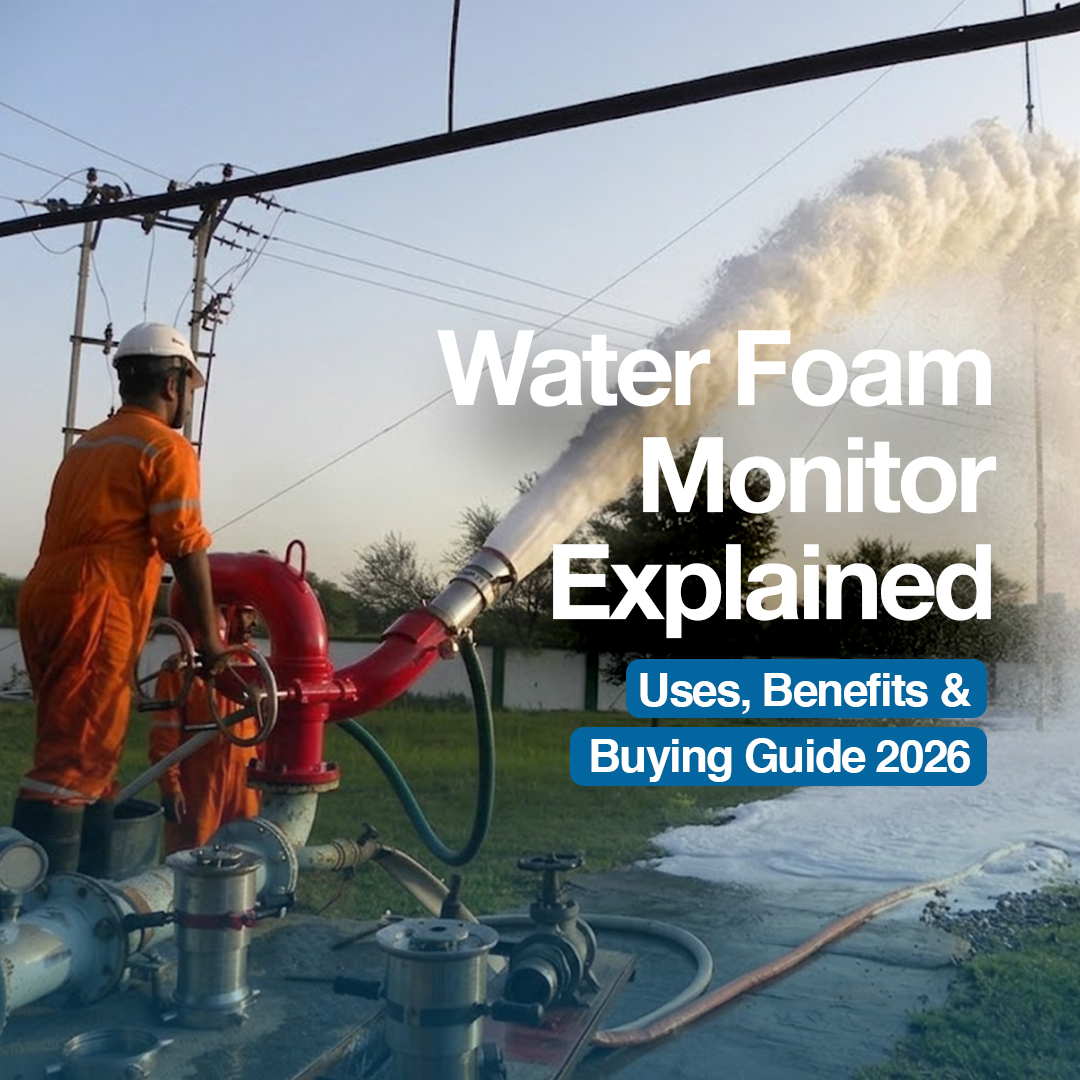
Some fire environments don’t give you time to improvise. Oil refineries, chemical plants, fuel storage terminals — the hazards here involve flammable liquids, high pressure, and conditions that can escalate faster than any standard hose reel can handle.
Water foam monitors were built for these situations. They push controlled streams of water, foam, or a combination of both over long distances, with enough force to actually suppress a serious fire rather than just slow it down. In 2026, with safety regulations tightening across industries, picking the wrong monitor isn’t just a purchasing mistake. It’s a liability.
How They Work
A water foam monitor — fixed or portable — mixes foam concentrate with water to produce a foam solution. That solution does something water alone can’t: it forms a blanket over flammable surfaces, cuts off oxygen, and prevents re-ignition. It’s mounted on fire trucks, on industrial structures, or at designated positions within high-risk facilities.
The range and output vary by model, but the purpose is consistent: get enough suppressant onto a fire, fast enough, before it spreads beyond control.
Where They’re Deployed
The standard applications are oil refineries, airports, chemical plants, and fuel storage terminals. Marine environments and large warehouses use them too, wherever a fire could spread quickly and where operator proximity to the fire is a genuine safety issue.
Special application water foam monitors handle the trickier scenarios — offshore platforms, hazmat storage, unusual site layouts where standard placement doesn’t work. These aren’t edge cases; they’re exactly the situations where having the right equipment matters most.
The Practical Advantages
Reach is the main one. Firefighters can operate from a safe distance rather than getting close to an active fire — which is critical in facilities where secondary explosions or chemical exposure are real risks.
Flexibility matters too. Being able to switch between water and foam depending on what’s burning makes these systems genuinely adaptable. And the good units are built to hold up in harsh conditions, which means they’ll actually function in an emergency rather than just during routine inspections.
What’s Available in 2026
Fixed monitors go into permanent industrial installations. Portable units give emergency teams flexibility to deploy where needed. Both come in manual and remote-controlled versions.
HVLR monitors — high volume long range — are built for large open-area applications: tank farms, airport aprons, refineries with wide-open layouts. When you need maximum throw distance and flow rate at the same time, these are usually the answer. Remote-controlled variants are increasingly common because they let operators manage the system from a safe position during active incidents.
Before You Buy
Flow rate, throw distance, pressure requirements, foam system compatibility — those are the technical basics. Material durability is easy to underestimate: offshore environments and chemical plants are hard on equipment in ways that don’t show up in spec sheets.
Maintenance requirements matter too. A monitor that needs specialist servicing regularly becomes a problem during the exact situations it was purchased for.
Akron Brass
Akron Brass, part of IDEX Corporation, has been building firefighting equipment for a long time. Their monitors are known for consistent performance under demanding conditions, and they’ve been adding remote operation capability and improved durability to more of their range. They’re not the only option, but they come up repeatedly in fire safety conversations for a reason.
IDEX FSG Akron Brass
IDEX FSG Akron Brass makes equipment for industrial fire protection and emergency response vehicles — applications where reliability is the baseline requirement, not a selling point. Their range includes configurations for special application water foam monitors in non-standard site environments, which is where a lot of the harder purchasing decisions happen.
IDEX India
India’s industrial growth has outpaced fire safety infrastructure in a number of sectors. IDEX India brings products like the Akron Brass range to Indian buyers, with local support and servicing rather than just import distribution. For facilities working within regulatory pressure and practical budget constraints, that local presence is more useful than it might sound on paper.
Bottom Line
Water foam monitors are infrastructure, not optional equipment, for high-risk industries. Getting the specification right — flow rate, site requirements, whether HVLR monitors suit your application, whether remote operation is a priority — means the system actually performs when it needs to. That’s the whole point.