
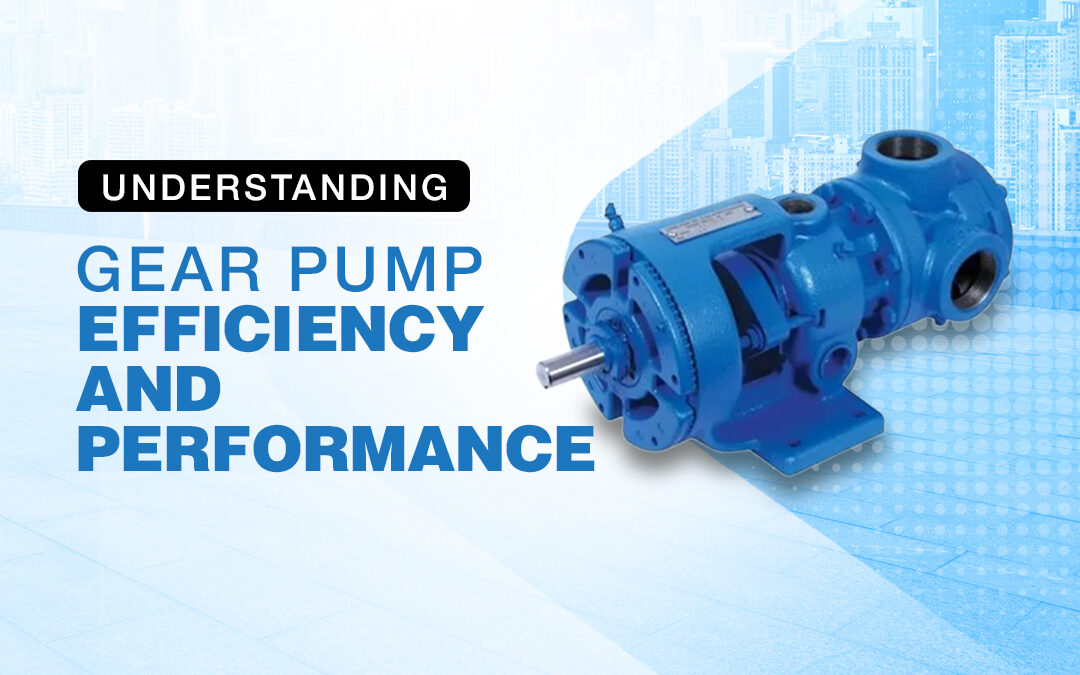
A positive displacement pump that uses a combination of meshing gears to displace fluids – that is a gear pump in a nutshell. Capable of moving highly viscous fluids with absolute precision and control, gear pumps are commonly used in industries such as chemical, petrochemical, food & beverages and pharmaceuticals.
So, how do gear pumps work? Well, they typically have two gears, which, once the pump is powered, rotate and trap the fluid between the gear teeth. So, at the inlet stage, the gears rotate, creating a low-pressure area and letting the pump take in the fluid. Thereafter, the fluid is trapped, as mentioned above, and carried around to the outlet of the pump. At this stage, high pressure is used to force the liquid out of the pump. By maintaining the consistency of rotation and pressure, a continuous and steady flow of the fluid is maintained.
Here are two common types of gear pumps:
External Gear Pumps
These pumps have two identical gears which rotate against each other to do the job. At the inlet stage, the two gears unmesh, creating a low-pressure area which helps the pump to draw in the fluid. With the fluid being carried at the outer edges of the pump, there is very little risk of any backflow. Eventually, high pressure is used again to move the fluid out of the pump.
Internal Gear Pumps
Unlike external gear pumps, these do not have identical gears. There is one external, larger gear with internal teeth and one smaller internal gear with external teeth. Once the fluid enters the pump, it is trapped between the teeth, moving only through the spaces between them. Once the teeth re-engage, we reach the outlet stage, where the fluid is pushed out of the pump.
Efficiency and performance of gear pumps
Gear pumps are known for their efficiency and performance, which are a result of several factors. For example, like all positive displacement pumps, gear pumps are designed to offer a consistent flow rate. This capability is primarily a top requirement for metering and dosing applications. Now, the precise, consistent flow directly affects how much liquid is pumped; there is no time wastage owing to the undesired consistency of the pumped fluid. Users get constant operation and a consistent output minus any losses due to friction, wear, and mechanical resistance within the gears, shafts, and bearings.
Secondly, gear pumps have minimal pulsation. While the fluid is on its journey from the pump inlet to the outlet, the flow is smooth with very little pulsation. This plays a vital role in the pump’s energy efficiency.
The performance of gear pumps is further exemplified by their compact design which enables optimal and efficient transmission of power while avoiding leakage. The leak-proof performance is especially useful for applications that handle high-viscosity fluids like oils and chemicals.
Most gear pumps can operate in high-pressure environments, which has two benefits. This capability makes them suitable for hydraulic systems and lubrication applications. And they do not shut down when pressure rises, which means gear pumps can offer non-stop performance.
Gear pumps are also self-primed. No manual priming is required before operation, and they can handle fluids effectively, even in applications where suction is necessary.
However, to enjoy maximum efficiency out of gear pumps, operators need to keep certain things in mind. The efficiency and performance of gear pumps are dependent on the compatibility between the pump’s body and the fluid that is to be moved. It is important to take a look at the operating conditions and the desired goals. Therefore, factors such as flow rate (the amount of fluid pumped per unit of time), pressure rating (to check if the pump can operate within the pressure range) and viscosity handling abilities (different designs are available in the market for different fluids) are to be considered.
And last but not least, it is also important to go for a good brand to get maximum pump efficiency. Viking pumps, operating under IDEX India, have been operational since 1911, offering advanced industrial products. Viking gear pumps can pump over 1400 kinds of fluids and are suitable for a broad range of applications. Their Universal line, including 1124A Series, 1127C Series, 1224A Series, 1227C Series, 123C Series, 124A Series, and 126A Series pumps offer reliable sealing to allow for a leak-proof operation.
The pumps are made of robust materials such as cast iron, stainless steel, and ductile iron, and promise superior performance for years. Integral jacket chambers help maintain an even temperature for constant, efficient heating. The pumps can handle various ranges of temperatures and pressures. Industries including mining, oil & gas, liquid sugars, refined fuels, edible oils, adhesives, starch, polymers, peanut butter, paints & inks, and pharmaceuticals have loved Viking gear pumps for decades now.
To learn more about Viking pumps and their features, click here – https://www.idexindia.in/viking-pumps/