
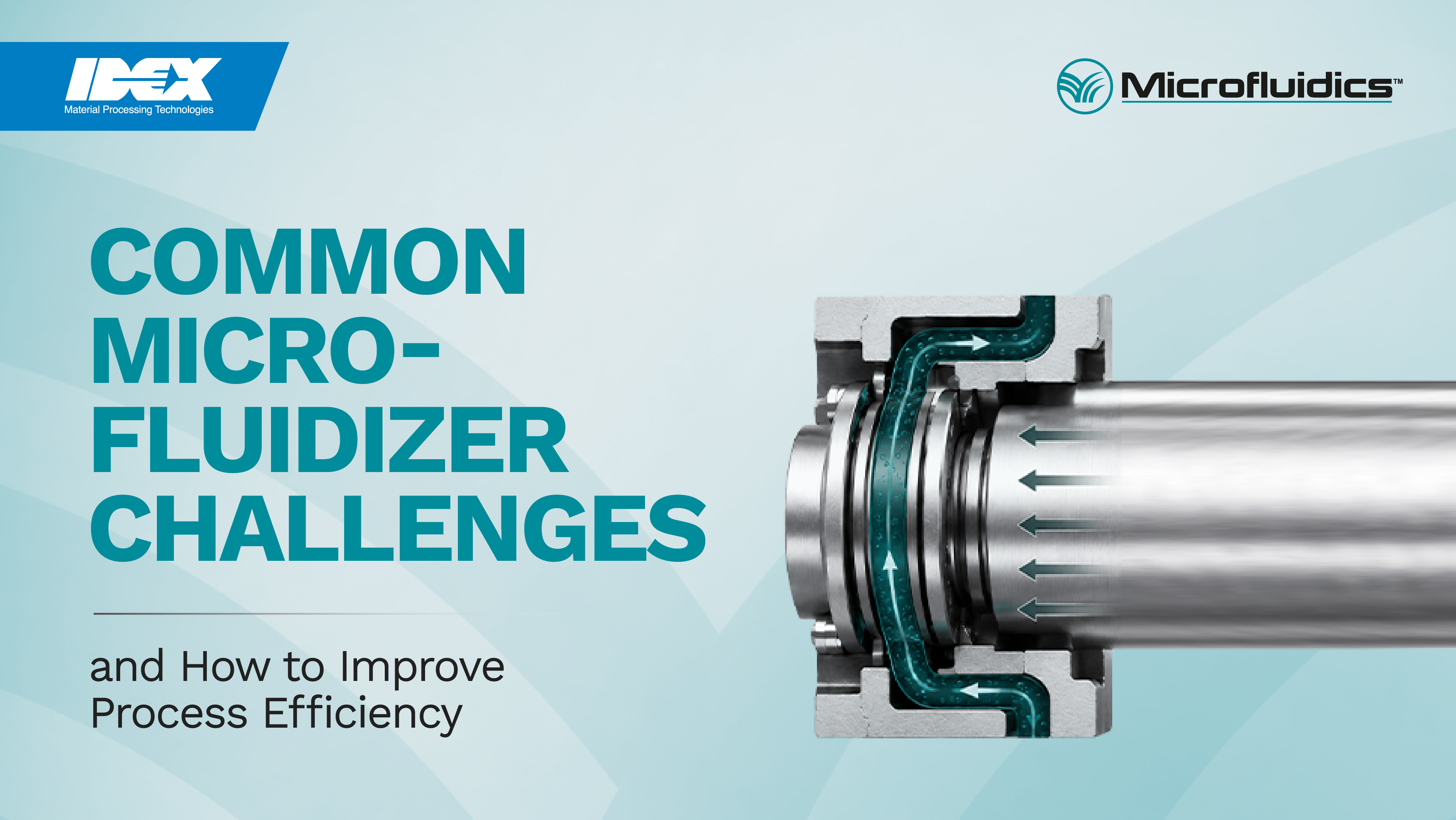
The microfluidization process improves particle size reduction by forcing a product stream through a precisely engineered interaction chamber at ultra-high pressure, creating intense shear, impact, and cavitation forces. The result is smaller particles, a narrower particle size distribution, and highly repeatable formulations.
Used across pharmaceutical, biotechnology, food, and personal care industries, the process improves product stability, batch consistency, and scale-up from laboratory research to commercial production. IDEX India supports these applications with scalable Microfluidics® systems.
What is the Microfluidization Process?
The microfluidization process is a high-pressure particle size reduction and deagglomeration technology used to produce stable emulsions, suspensions, dispersions, liposomes, and nanoparticles. Differing from conventional homogenization methods, a microfluidizer forces the product through fixed-geometry interaction chambers under precisely controlled pressure, delivering highly uniform processing conditions.
High shear, impact, and cavitation forces break apart agglomerates to produce smaller, more uniform particles. This creates a narrow particle size distribution (PSD) and improves formulation stability across pharmaceutical, biotechnology, food, and specialty chemical applications.
How Does a Microfluidizer Reduce Particle Size?
A microfluidizer achieves particle size reduction by forcing formulations through a precisely engineered interaction chamber at ultra-high pressure. Unlike mechanical milling, which relies on grinding, the microfluidization process uses fluid dynamics to create controlled particle disruption while preserving sensitive formulations.
What Happens Inside the Interaction Chamber?
The formulation passes through fixed microchannels where intense shear, impact, turbulence, and cavitation break apart agglomerates and produce fine, uniform particles. This process:
- Reduces particle size
- Creates a narrow particle size distribution
- Improves emulsion and suspension stability
- Delivers consistent batch-to-batch performance
Why Does Pressure Control Matter?
Operating pressure directly influences particle size and formulation performance, so it should be optimized according to viscosity and target particle size. The Microfluidics® laboratory systems from IDEX India provide manufacturers with flexibility across different development stages:
| System | Maximum Pressure | Minimum Sample Size | Flow Rate |
|---|---|---|---|
| LM10 | Up to 23,000 psi | 14 ml | Laboratory development |
| LM20 | Up to 30,000 psi | 14 ml | Advanced formulation development |
| M-110P | Up to 30,000 psi | 36 ml | Up to 120 ml/min |
The M-110P also features a 7-inch HMI, an ASME-BPE-compliant design, CE marking, and an upgrade path for full cGMP operation, making it suitable for various chemical process development and validation.
How Can You Optimize the Microfluidization Process?
Optimizing the microfluidization process requires balancing formulation properties and processing parameters to achieve consistent particle size reduction without affecting product stability. Key best practices include:
- Use a consistent feed material: Uniform particle size and appropriate viscosity improve processing efficiency and repeatability.
- Optimize pressure gradually: Increase pressure in stages to achieve the desired particle size while reducing energy use and formulation stress.
- Control product temperature: Cooling systems help protect heat-sensitive products such as vaccines, biologics, liposomes, and protein formulations.
- Minimise the number of passes: Use only as many passes as needed to avoid excess heat generation and longer processing times.
- Monitor critical quality attributes: Evaluate particle size distribution (PSD), polydispersity index (PDI), and batch consistency rather than average particle size alone.
- Plan for scale-up: Select systems that maintain consistent processing conditions from laboratory to commercial production, simplifying technology transfer and validation.
Don’ts of the Microfluidization Process
Poor process control can reduce product quality and repeatability. Avoiding the following mistakes helps maintain product quality, process efficiency, and repeatable particle size reduction.
- Operating at maximum pressure for every formulation, as excessive pressure can increase energy consumption and place unnecessary stress on sensitive products.
- Running more passes than required, which may generate excess heat, extend processing time, and affect formulation stability.
- Processing feed materials with inconsistent particle size or viscosity, leading to variable particle size reduction and reduced repeatability.
- Neglecting temperature control when handling heat-sensitive products such as biologics, proteins, liposomes, and nanoemulsions.
- Focusing only on average particle size instead of evaluating particle size distribution (PSD), product stability, and batch-to-batch consistency.
By monitoring these factors and optimizing process parameters, manufacturers can achieve more consistent formulations, reliable scale-up, and improved overall manufacturing performance.
Where is the Microfluidization Process Used?
Microfluidization solutions are used across industries that require precise particle size reduction, narrow particle size distribution, and stable formulations. Its ability to produce highly uniform particles improves product quality, consistency, and process efficiency across a wide range of applications.
- Pharmaceutical and Biotechnology: Used for nanoemulsions, liposomes, lipid nanoparticles (LNPs), biologics, vaccines, suspensions, and injectable formulations, supporting batch consistency, contamination control, and GMP compliance.
- Food and Beverage: Produces stable emulsions for fortified beverages, dairy alternatives, sauces, dressings, and functional ingredients while improving texture, dispersion, and shelf stability.
- Personal Care and Cosmetics: Creates uniform creams, lotions, sunscreens, serums, and cosmetic emulsions with improved appearance, stability, and product performance.
- Specialty Chemicals: Processes pigments, coatings, engineered dispersions, and advanced materials, delivering consistent particle size, improved dispersion, and reliable downstream processing.
Why Choose Microfluidics® Systems from IDEX India?
Choosing the right microfluidizer depends on your formulation, production scale, and long-term manufacturing goals. Key factors to evaluate include operating pressure, sample size, flow rate, temperature control, cleaning and validation requirements, scalability, and compliance with standards such as ASME-BPE and cGMP. Microfluidics® systems from IDEX India are designed to simplify this process by offering seamless scale-up from laboratory research to commercial production. Key advantages include:
- Operating pressures up to 30,000 psi for precise particle size reduction.
- Scalable lab-to-production systems with consistent processing performance.
- Wear-resistant interaction chambers and Clean-in-Place (CIP) capability for improved reliability and hygiene.
- ASME-BPE-compliant, cGMP-ready designs for regulated industries.
- Local engineering, commissioning, and after-sales support from IDEX India.
For high-volume manufacturing, the Microfluidics® systems combine high-pressure processing with CIP capability and durable interaction chambers, helping manufacturers achieve reliable scale-up, consistent product quality, and efficient long-term operation.
Conclusion
Microfluidization solutions have become one of the most effective technologies for achieving precise particle size reduction, narrow particle size distribution, and highly stable formulations. Across pharmaceutical, biotechnology, food, and specialty chemical manufacturing. By combining high-pressure processing with controlled shear, impact, and cavitation forces, it improves product quality, batch consistency, contamination control, and overall manufacturing efficiency.
With Microfluidics® solutions, IDEX India supports manufacturers throughout the entire product lifecycle, from laboratory formulation technology and process optimization to pilot studies and commercial production. With scalable equipment and local engineering support, IDEX India helps manufacturers achieve reliable scale-up and consistent product quality.
FAQs
1. What is the difference between homogenization and microfluidization?
While both processes reduce particle size, microfluidization uses fixed-geometry interaction chambers operating at ultra-high pressure to generate controlled shear, impact, and cavitation forces. This produces narrower particle size distributions and greater batch consistency than conventional homogenization.
2. How many checks are required in the microfluidization process?
The number of passes depends on the formulation, target particle size, and stability requirements. Many formulations achieve the desired particle size within one to three passes, although optimization should balance particle reduction with heat generation.
3. Can microfluidization process heat-sensitive formulations?
Yes. Microfluidization is widely used for biologics, vaccines, proteins, liposomes, and other temperature-sensitive formulations when combined with effective cooling systems to maintain product stability throughout processing.
4. What pressure is typically used for particle size reduction?
Processing pressure depends on the formulation technology and target particle size. Laboratory and production Microfluidics® systems from IDEX India operate at pressures of up to 30,000 psi, enabling precise and repeatable particle size reduction across a wide range of applications.