
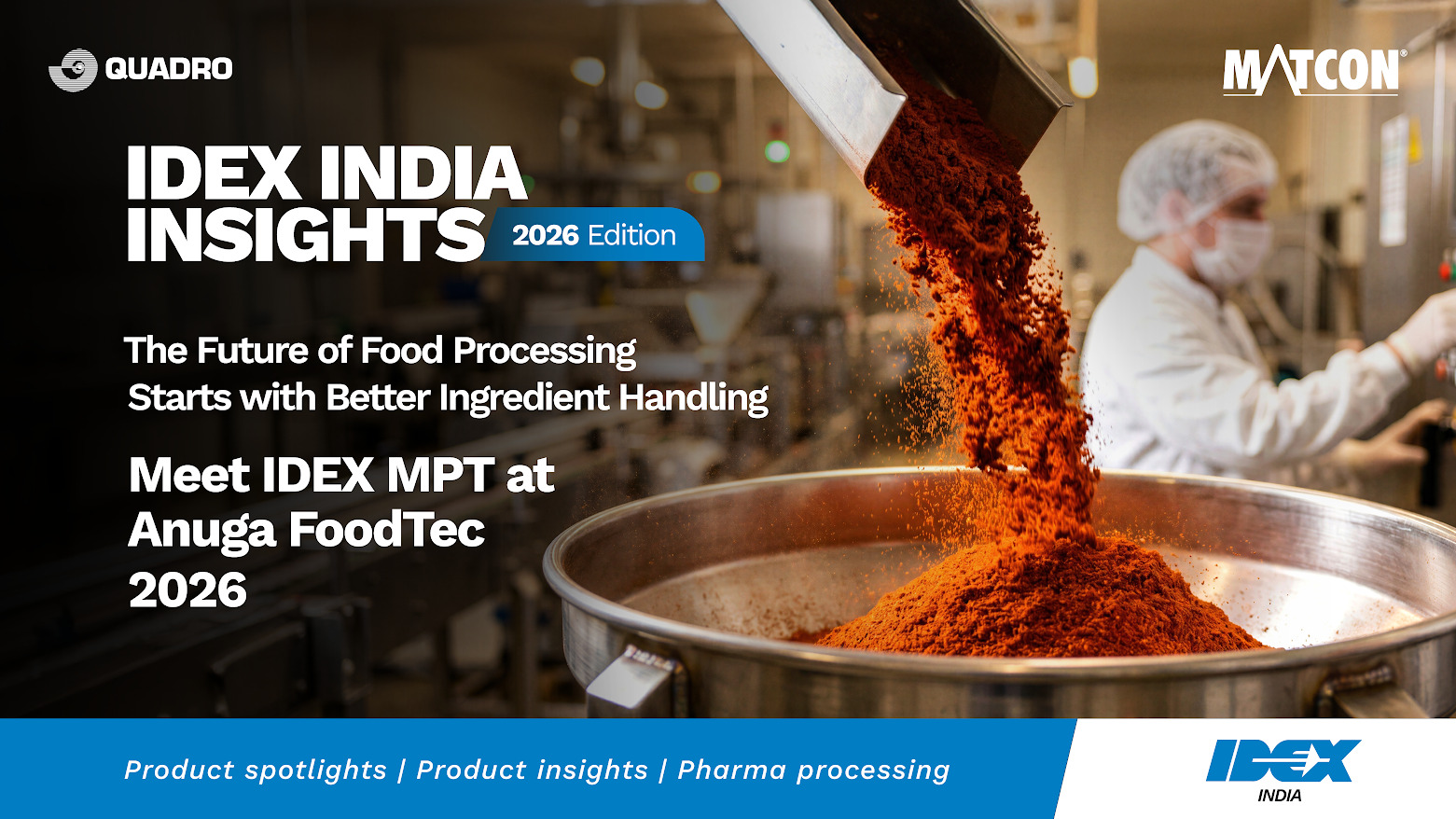
In food manufacturing, consistency is often judged by the final product.
But many of the factors that determine that consistency are introduced much earlier, when ingredients are handled, transferred, blended, discharged, screened and sized.
Powdered ingredients rarely behave exactly the same way. Differences in particle size, bulk density and flow characteristics can contribute to challenges such as bridging, segregation, agglomeration, dust generation and inconsistent discharge. If these issues are not managed upstream, they can create complications further down the production line.
That is why the future of food processing is not only about faster equipment or greater automation.
It is also about creating better control over what happens to ingredients between one process stage and the next.
Ingredient Handling Is More Than Moving Powder
Moving an ingredient from one stage to another may appear straightforward. In practice, what happens during that movement matters.
A well-mixed powder can segregate during discharge. Cohesive ingredients can bridge or rat-hole. Recipe changes can introduce additional cleaning requirements, while uncontrolled powder movement can increase dust and cross-contamination concerns.
For manufacturers managing multiple recipes and ingredients, these challenges can accumulate across the production cycle.
This is where a more flexible approach to powder handling becomes important.
Matcon Intermediate Bulk Container (IBC) systems are designed around decoupling key manufacturing stages such as formulation, blending, packing and cleaning. Individual activities can take place with greater independence, helping manufacturers create a more flexible production flow.
The IBC can also become the blending vessel, while Matcon’s Cone Valve technology supports controlled powder discharge and addresses common flow problems including bridging, rat-holing and segregation.
Because the product remains within the IBC through different stages, cleaning can also be moved offline rather than keeping the blender unavailable between every recipe change.
But Good Handling Is Only Part of the Equation
Even when ingredients move reliably, their physical condition can affect what happens next.
Agglomerates, irregular particles or an unsuitable particle size distribution can influence how powders flow, mix and perform in downstream processes.
This makes particle conditioning, milling and screening another important part of process control.
Quadro provides technologies for particle size reduction, deagglomeration, delumping and screening across food-processing applications.
The Quadro® Comil uses conical milling to condition powders toward the required particle size distribution, while the Quadro® FlexSift provides inline screening and gentle deagglomeration.
For process-sensitive food ingredients, the G96 Food Mill is designed for precise milling and deagglomeration, offering flexibility across different materials and production requirements.
The objective is not simply to make particles smaller.
It is to create the right powder characteristics for the next stage of the process.
Looking at the Process as a Connected Journey
Ingredient handling and particle processing may be discussed as separate operations, but on the production floor, one influences the other.
A powder may need to be:
Formulated → Blended → Transferred → Discharged → Screened or Milled → Sent to the Next Process Stage
A problem at any one of these handovers can affect overall consistency.
This is where the complementary expertise of Matcon and Quadro within IDEX Material Processing Technologies becomes relevant.
Matcon focuses on how powders are contained, moved, blended and discharged, while Quadro focuses on how their particle characteristics are conditioned through milling, sizing, deagglomeration and screening.
The bigger opportunity is to look beyond individual machines and ask:
How can each stage prepare the ingredient more effectively for what comes next?
Better Processing Begins with Better Questions
For food manufacturers, improving a line does not always begin with increasing speed.
It can begin with asking:
- Is ingredient flow predictable from batch to batch?
- Is blend uniformity being maintained during discharge and transfer?
- Are recipe changes creating unnecessary production interruptions?
- Are agglomerates affecting downstream processing?
- Is the particle size entering the next stage appropriate for the application?
These questions can reveal opportunities that are easily missed when every machine is evaluated independently.
Continue the conversation at Anuga FoodTec India 2026
As food manufacturers manage more complex formulations and greater production demands, ingredient handling and processing will play an increasingly important role in overall process performance.
The right technologies can help manufacturers take greater control of powder flow, blend integrity, particle characteristics and production flexibility, creating a more reliable path from ingredient to finished product.
IDEX MPT will be exhibiting at Anuga FoodTec India 2026, bringing Matcon and Quadro together to showcase solutions for food manufacturers looking to improve their ingredient-handling and powder-processing operations.
The future of food processing starts with better control over the ingredient.
Meet Matcon and Quadro at Anuga FoodTec India 2026 to explore smarter approaches to powder handling, blending, discharge, milling, screening and deagglomeration.
Have a processing challenge? Bring it to us. Let’s talk.
29 September – 1 October 2026 | Bombay Exhibition Centre, Mumbai