
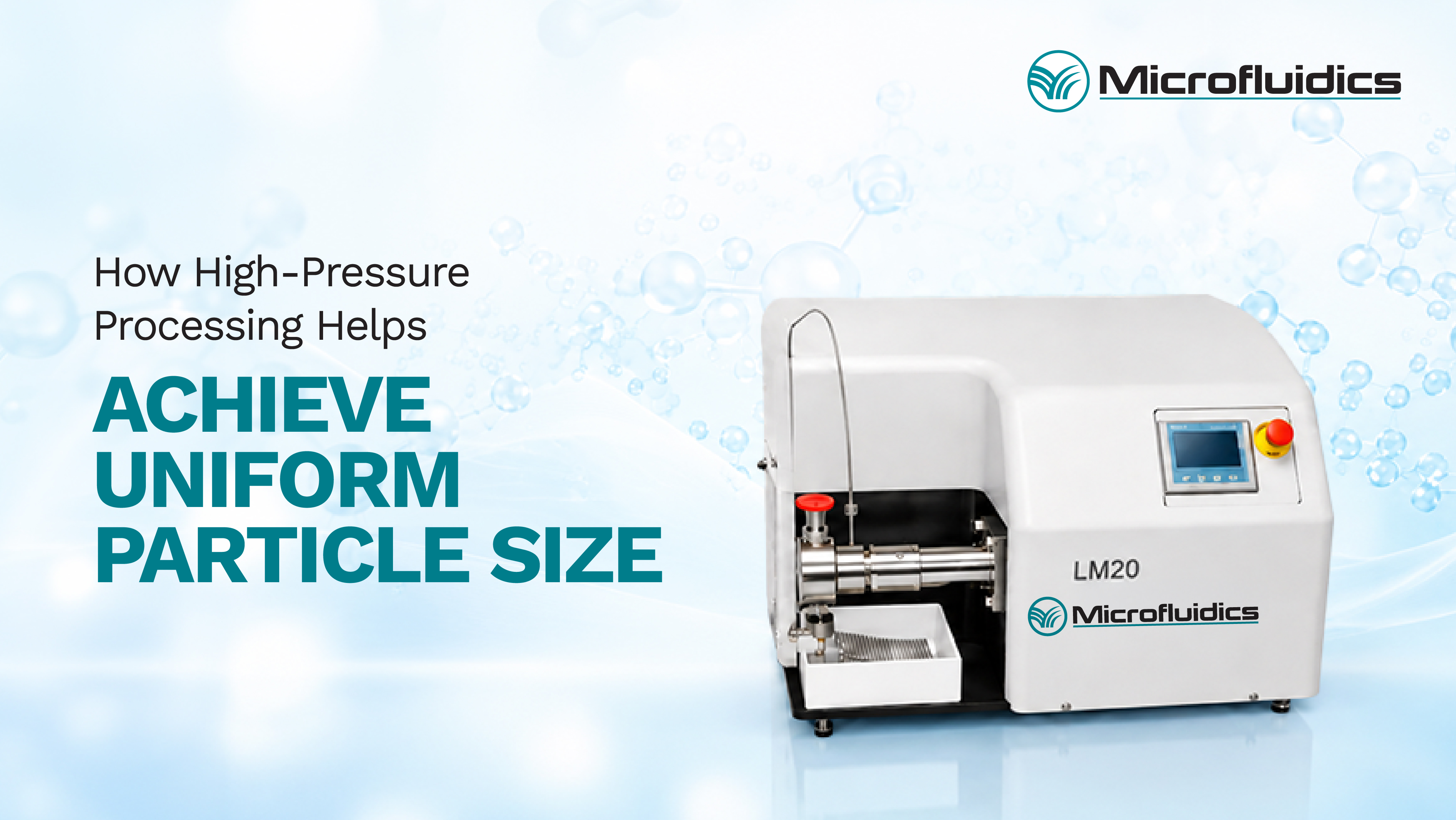
High-pressure processing achieves uniform particle size by forcing liquid formulations through a precisely designed interaction zone at high pressure. As the fluid passes through this narrow path, it experiences intense shear, impact, turbulence, and cavitation. These forces break down large particles, droplets, and agglomerates into smaller, more consistent sizes. The whole process is carried out through a high-pressure homogenizer that pumps the product at controlled pressure through a defined interaction chamber.
In essence, high-pressure processing defines the underlying methodology, while the high-pressure homogenizer serves as the engineered system that precisely executes this process.
Why Is Uniform Particle Size Important?
High-pressure processing plays a pivotal role across pharmaceuticals, biotechnology, food, cosmetics, nutraceuticals, and fine chemical industries. Uniform particle size directly affects how a formulation performs during processing, storage, and end use. When particle or droplet sizes vary too much, the product may become unstable. It may separate, settle, block filters, show uneven texture, or deliver inconsistent performance.
For technical teams, uniformity supports:
- Better suspension and emulsion stability
- Consistent quality from batch to batch
- Predictable product performance
- Easier quality checks and validation
- Lower risk of separation or agglomeration
- Smoother scale-up from lab to production
In pharmaceutical and biotech applications, particle size can also influence dissolution, absorption, delivery efficiency, and formulation reliability.
How Does a High-Pressure Homogenizer Support Particle Size Reduction?
A high-pressure homogenizer uses controlled pressure to process liquid formulations. The product is pressurised and pushed through a small, fixed pathway or interaction chamber. As the fluid accelerates through this zone, strong mechanical forces act on the particles or droplets.
The process supports particle size reduction in three main ways.
1. It Breaks Down Larger Particles and Droplets
High shear and impact forces reduce larger particles or droplets into finer sizes. This is useful for emulsions, suspensions, dispersions, liposomes, nanosuspensions, and other liquid-based systems that need precise particle control.
2. It Separates Agglomerates
Many formulations contain particle clusters formed during mixing, storage, or upstream processing. High-pressure processing helps break these clusters apart and distribute the material more evenly through the liquid.
3. It Creates a Narrower Size Distribution
Smaller particles alone are not enough. The real value lies in achieving a more consistent and uniform particle size. A narrow particle size distribution helps improve formulation stability, appearance, flow behaviour, and repeatability.
How the High-Pressure Homogenizer Achieves Uniform Particle Size
The answer lies in controlled energy delivery. In a well-designed high-pressure homogenizer, the formulation passes through a defined interaction zone under repeatable pressure and flow conditions. This ensures that the material receives consistent processing energy during each pass.
Process engineers can control key parameters such as:
- Operating pressure
- Number of passes
- Flow rate
- Product temperature
- Interaction chamber design
- Formulation viscosity
- Solids concentration
By adjusting these variables, teams can achieve uniform particle size reduction without over-processing sensitive materials. This is especially important for formulations affected by heat, oxidation, excessive shear, or instability.
Applications in Particle Size Reduction
High-pressure processing is used for particle size reduction wherever fine, stable, and repeatable liquid formulations are required.
Pharmaceutical Processing
In pharma, uniform particle size reduction in pharmaceutical processing supports better formulation consistency, drug delivery performance, and batch reliability. It is commonly used for nanosuspensions, liposomes, lipid-based carriers, injectable formulations, and controlled-release systems.
Nanoemulsions
A high-pressure homogenizer for nanoemulsions helps create very fine droplets with a narrow distribution. This improves emulsion stability and can support better texture, appearance, absorption, or active ingredient delivery, depending on the formulation.
Biotechnology
High-pressure systems are used for cell disruption, protein recovery, and biologics-related processing. Controlled pressure and repeatable shear help improve process consistency and yield.
Cosmetics and Personal Care
Creams, serums, lotions, and active delivery systems often depend on fine particle or droplet control. Uniformity helps improve texture, stability, spreadability, and product feel.
Food and Nutraceuticals
High-pressure homogenization supports stable beverages, emulsions, encapsulated ingredients, and functional formulations where mouthfeel, shelf stability, and ingredient dispersion matter.
What Problems Does High-Pressure Homogenization Solve?
Inconsistent particle size can create serious production and quality issues. Common problems include phase separation, sedimentation, poor dispersion, blocked filters, unstable emulsions, inconsistent viscosity, and failed quality checks.
A high-pressure homogenization system helps address these challenges by delivering:
- Controlled particle size reduction
- Better dispersion and deagglomeration
- Improved formulation stability
- Repeatable batch quality
- Easier scale-up from development to production
- More consistent product performance
This makes the technology useful for manufacturers that need both precision and repeatability in liquid processing.
What Should You Consider When Selecting a High-Pressure Homogenizer?
The right system depends on the formulation, target particle size, process scale, and quality requirements. Important factors include:
Pressure Capability
Higher pressure can increase shear intensity, but the ideal pressure depends on the material, viscosity, and target particle size.
Scalability
A process developed in the lab should be repeatable at the pilot and production scales. This is especially important in pharmaceutical and high-value applications.
Temperature Control
Some formulations are heat-sensitive. Efficient cooling and controlled processing help protect material quality.
Material Compatibility
The system should suit the formulation’s viscosity, abrasiveness, hygiene needs, and chemical compatibility.
Repeatability and Validation
For regulated industries, repeatable processing conditions support documentation, process control, and validation.
Why Does This Matter for Product Quality?
Particle size influences stability, texture, bioavailability, flow behaviour, absorption, and final product performance. When particle size is controlled, manufacturers can reduce variation and improve confidence in every batch.
For R&D teams, this supports faster formulation development. For production teams, it helps reduce defects and improve output consistency. For quality teams, it enables tighter process control.
Conclusion
Achieving consistent particle size is a key step toward building reliable, high-performing formulations across industries. With the right processing approach and equipment, teams can improve efficiency, reduce variability, and support long-term product success.
For manufacturers focused on consistency and performance, the right high-pressure homogenization system can become a critical part of reliable processing.
Microfluidics by IDEX Corp. supports your business in high-pressure processing to meet the demands of regulated and high-performance applications. To know more, connect with our team today or explore our tailored high-pressure homogenization solutions.