
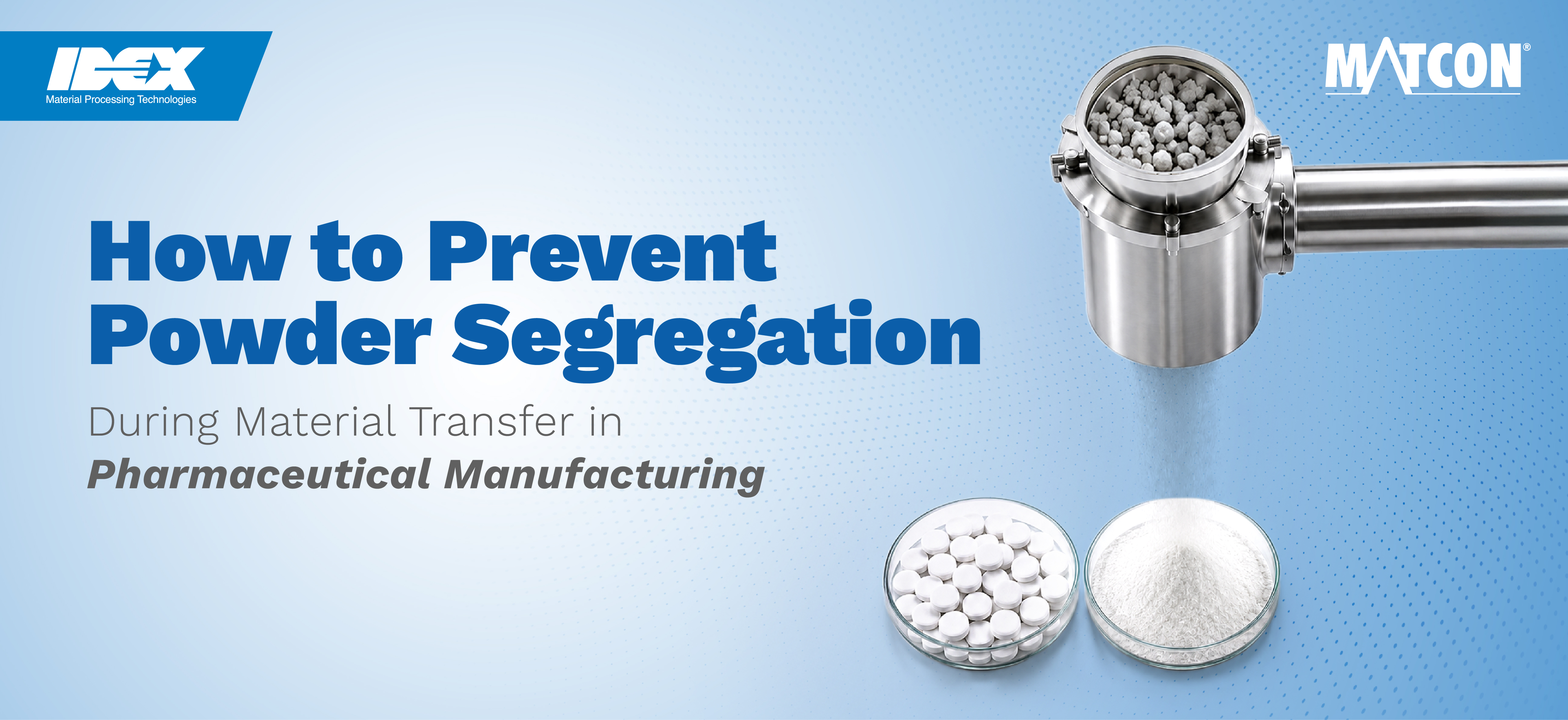
To prevent powder segregation during material transfer in pharmaceutical manufacturing, processing plants must switch from traditional butterfly valve containers to Intermediate Bulk Container (IBC) systems featuring Cone Valve technology. Standard discharge methods cause core flow, rat-holing, and particle separation when moving blended powders from blenders to tablet presses or capsule fillers.
Controlled discharge via a rising cone valve promotes mass flow, ensuring particles of varying sizes and densities move uniformly. Pharmaceutical manufacturers rely on these closed, automated powder handling systems to guarantee batch consistency, preserve active pharmaceutical ingredient (API) potency, lower labour costs, and maintain cleanroom hygiene across high-speed production lines.
What Causes Powder Segregation During Material Transfer?
In solid dosage manufacturing, moving dry powders across processing steps introduces mechanical forces that disrupt homogeneous mixtures. Because active ingredients and excipients vary in particle size, shape, and bulk density, discharging them from standard hoppers causes smaller particles to slip through voids while larger ones roll to the edges, resulting in severe dose uniformity variations.
Demixing occurs primarily through three physical mechanisms:
- Trajectory Segregation: Larger, denser particles travel further through air streams during container filling.
- Percolation: Fine particles filter downward through void spaces between larger particles during vibration or movement.
- Elutriation (Air Fluidisation): Fine airborne particles remain suspended longer during rapid dumping and settle unevenly on top of the batch.
Why Is Preventing Powder Segregation Critical in Pharmaceutical Manufacturing?
Uncontrolled particle separation directly damages product quality, increases batch rejection rates, and reduces operational efficiency. The primary risks of powder demixing in pharmaceutical production include:
Out-of-Specification (OOS) Batches:
- Fluctuations in active ingredient concentration lead to inconsistent API potency across the batch.
- Increased Operational Downtime: Frequent stops for machine cleaning, recalibration, and line adjustments lower overall equipment effectiveness.
- High Product Waste: Significant API and excipient loss occurs during tabletting or encapsulation due to uneven powder feeds.
- Regulatory Non-Compliance: Non-uniform batches fail Content Uniformity audits mandated by health authorities.
When demixing occurs upstream, tablet compression machines receive non-uniform powder feeds. Tablets compressed at the beginning of a discharge run may contain excess excipients, while tablets compressed at the end receive concentrated API doses.
This variability leads to batch failures during Content Uniformity testing, forcing plants to scrap valuable material. Furthermore, airborne dust generated by segregated fine particles compromises cleanroom containment, increases cross-contamination risks, and threatens operator safety.
How Does Matcon Cone Valve Technology Prevent Demixing?
Traditional powder handling relies on rotary or butterfly valves that open from the centre, creating funnel flow where powder at the top drains rapidly through a central core while material along the hopper walls remains stationary. This differential flow velocity triggers severe particle separation and demixing during fluid and solid material discharge.
To solve this challenge, IDEX India provides specialised Matcon IBC systems equipped with patented Cone Valve technology positioned at the container’s bottom outlet. During discharge, an automated unit lifts the cone upward into the powder bed to form an annular opening around the hopper perimeter, forcing material to move simultaneously across the entire cross-section of the bin to establish uniform mass flow (First-In, First-Out) and eliminate dead zones, rat-holing, bridging, and powder segregation.
How Do Handling Systems Compare for Powder Integrity?
Selecting the right powder transfer platform determines whether a plant achieves continuous batch consistency or suffers constant quality failures. The table below compares traditional discharge containers against advanced Matcon IBC Cone Valve systems.
| Operational Performance Factor | Traditional Butterfly Valve Bins | Matcon Cone Valve IBC Systems |
|---|---|---|
| Powder Discharge Pattern | Funnel flow; causes central rat-holing and dead zones | Mass flow; creates uniform, first-in-first-out discharge |
| Risk of Powder Segregation | High; particles separate by size and density during flow | Minimal; annular flow gap preserves blend integrity |
| Flow Control & Dosing | On/off switching; prone to sudden powder flushing | Variable lift heights for controlled discharge and dosing |
| Partial Discharge Capability | Poor; closing valve under flow crushes particles | Excellent; cone can lower mid-batch to stop flow safely |
| Dust Containment Level | Open to atmosphere; high dust exposure | Closed, dust-tight transfer via automated seals |
| Cohesive Powder Handling | Prone to bridging and complete flow blockage | Integrated vibration breaks bridges and fluidises cohesive mix |
Where Are Matcon Powder Handling Systems Applied in Process Plants?
Integrated powder processing solutions are deployed across multiple stages of solid dosage production to guarantee seamless, containment-friendly material flow:
Direct IBC Formulation and Loading
Raw materials are charged directly into sealed Matcon IBCs. This enclosed transfer avoids open scooping, protects operators from potent compound dust, and maintains strict cleanroom hygiene.
In-Container Tumble Blending
Rather than transferring blended powders from a fixed mixer into transport bins, the entire Matcon IBC attaches directly to a tumble blender. Blending inside the sealed container eliminates the transfer step, removing the primary opportunity for particle demixing while eliminating blender cleaning downtime.
Continuous Feeding to Compression and Packaging
During tablet press feeding, the Matcon IBC docks directly above the tablet press hopper. The automated Cone Valve modulates its lift height to feed powder on demand, preventing hopper overfilling and maintaining uniform feed density for optimal tablet weight control.
What Are the Key Selection Factors for Powder Transfer Systems?
When upgrading powder processing lines to eliminate demixing, processing engineers should evaluate several critical hardware parameters:
Variable Lift Height and Flow Automation
Different powder formulations require varying discharge rates. Systems featuring adjustable cone lift heights allow operators to fine-tune flow rates to match downstream tablet press or capsule filling speeds without causing mechanical stress to the particles.
Integrated Vibrational Assistance
Sticky, cohesive powders often resist initial flow. Advanced discharge stations feature pulse-vibration systems applied directly to the Cone Valve. This targeted force breaks bridges and encourages smooth mass flow without transferring vibration to the main container structure.
Containment and Cleaning Validation
To meet stringent cGMP guidelines, handling systems must feature closed transfer couplings that trap fine particulates. Furthermore, utilising offline automated wash stations allows facilities to clean containers thoroughly between batches without stopping the main production line.
Conclusion
Preventing powder segregation during material transfer is essential for pharmaceutical manufacturers striving to guarantee dose uniformity, reduce batch rejections, and maximise Overall Equipment Effectiveness (OEE). Traditional discharge methods cause particle demixing through funnel flow, resulting in inconsistent tablet weights and compromised active ingredient distribution.
By transitioning to fully enclosed, automated Matcon IBC systems featuring Cone Valve technology, processing plants achieve true mass flow, preserve blend integrity, and eliminate airborne dust. Investing in engineered powder handling systems directly protects product quality, lowers operational overhead, and ensures compliance with global cGMP standards. To explore customised solid dosage containment and material handling solutions across India, consult the experts at IDEX India.