
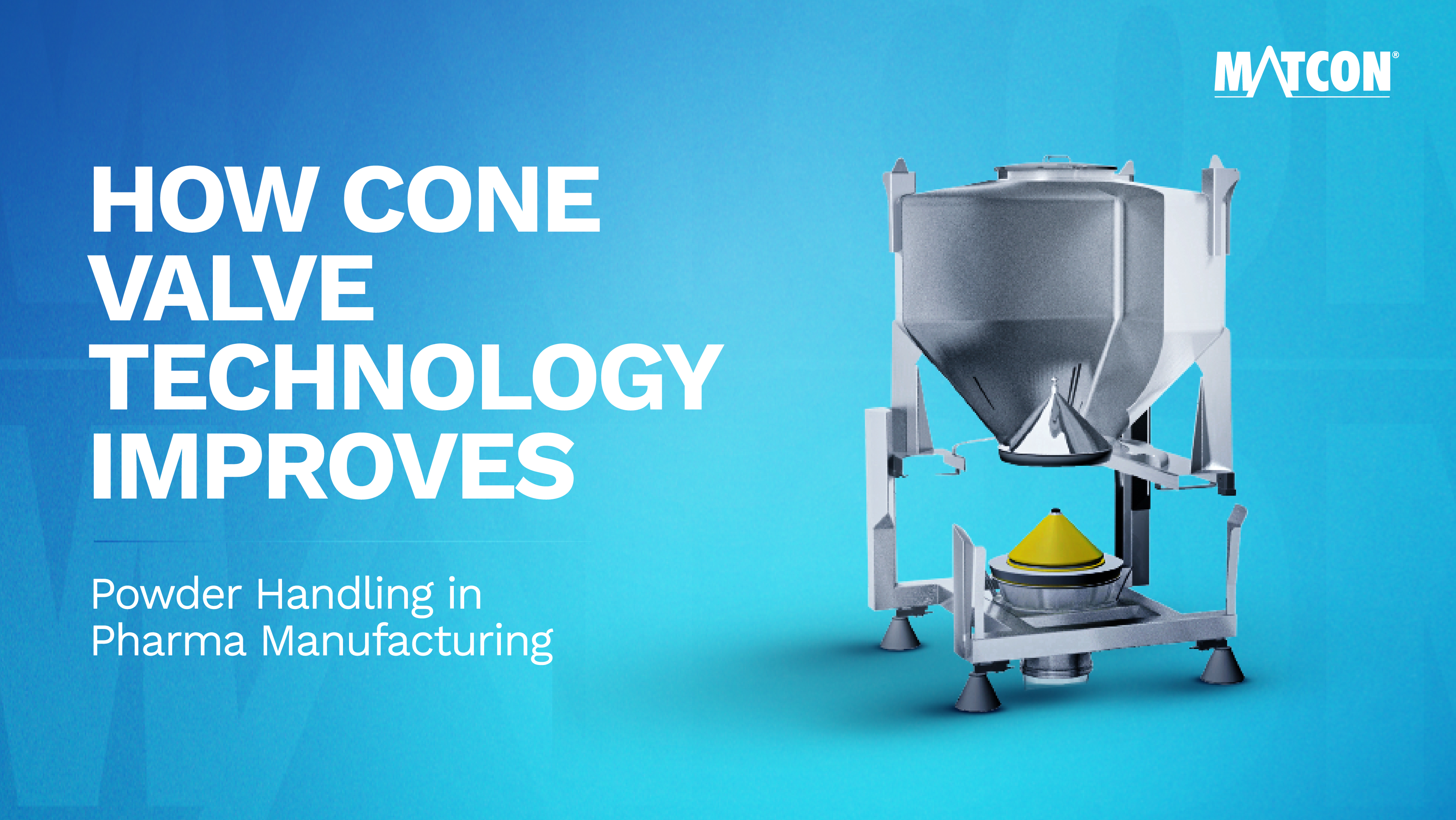
Cone valve technology improves powder handling in pharma manufacturing by enabling controlled, uniform and contained discharge of powders from an IBC. Instead of allowing material to flow unevenly, the cone valve lifts to create a controlled opening at the outlet. This helps powders move in a consistent mass-flow pattern, reducing segregation, bridging, ratholing, dust exposure and manual intervention.
For pharmaceutical manufacturers, this supports batch consistency, operator safety, hygiene, contamination control and process efficiency. In oral solid dosage manufacturing, powder behaviour directly affects tablet quality, blend uniformity and production uptime. That makes the discharge system a critical part of the manufacturing process.
What Is Cone Valve Technology in Pharma Powder Handling?
Cone valve technology is a discharge system used in Intermediate Bulk Containers, or IBCs, to control how powders, granules and blended materials flow out of the container.
In an IBC cone valve system for pharma manufacturing, the cone-shaped valve sits at the base of the container. During discharge, the cone lifts in a controlled manner to create a precise opening. This allows powder to flow evenly across the outlet rather than from only one section of the container.
This matters because pharmaceutical powders can be cohesive, sticky, dusty, moisture-sensitive or prone to separation. Cone valve technology for pharmaceutical powder handling helps create a more predictable discharge pattern for such materials.
Why Is Powder Handling Difficult in Pharma Manufacturing?
Powder handling in pharma manufacturing becomes difficult as powders behave differently depending on particle size, density, moisture content, formulation type and flow properties.
A powder that flows well during one stage may become difficult to discharge after blending, storage or transfer. This can create production, quality and safety risks.
Common powder handling challenges include:
- Segregation: Particles separate based on size, weight or density, affecting blend uniformity.
- Bridging: Powder forms an arch over the outlet and stops flowing.
- Ratholing: Powder flows only from the centre, while material remains stuck along the container walls.
- Dust generation: Fine powders escape during transfer, creating safety and contamination concerns.
- Manual intervention: Operators may need to tap, shake or disturb containers to restart flow.
In pharma, these problems can affect dosage consistency, cleaning time, batch release timelines and operator safety.
How Does Cone Valve Technology Help?
In many traditional discharge systems, powder may flow from the centre first while material near the walls remains stationary. This uneven flow can cause finer or heavier particles to separate, especially in multi-ingredient blends.
A cone valve works differently. It creates a controlled opening at the IBC outlet, allowing material to move across the container cross-section. This supports mass-flow discharge, where the blend moves together rather than separating into different layers.
A powder handling system to prevent segregation and bridging must control how material starts, flows and stops during discharge.
Cone valve technology helps by gently lifting the powder from the base of the IBC and creating a controlled flow path. This movement helps break stagnant zones and allows difficult powders to discharge more reliably.
It helps address:
- Bridging: The cone movement helps disturb the powder arch that may form over the outlet.
- Ratholing: The controlled discharge pattern encourages material from across the container to move, not only the centre core.
- Sticky or compacted powders: Controlled flow reduces the need for excessive tapping, shaking or manual handling.
This makes cone valve technology useful in processes such as feeding tablet presses, roller compactors, granulators, sieving systems and downstream packing lines.
Where Is Cone Valve Technology Used in Pharma Manufacturing?
Cone valve technology is used in pharmaceutical powder and tablet handling systems where controlled transfer, contained discharge and blend uniformity are required.
1. Oral Solid Dosage Manufacturing
In tablet and capsule production, powders often contain active pharmaceutical ingredients, fillers, binders, lubricants and excipients. These ingredients may have different particle sizes and densities. Cone valve technology helps protect the blend during discharge from the IBC to the next process stage.
2. Feeding to Tablet Compression
Before compression, the powder blend must remain consistent. If segregation occurs during discharge, tablets may show variation in weight, hardness or content uniformity. An IBC cone valve system helps maintain controlled feeding to downstream equipment.
3. Granulation and Compaction
Dry granulation, wet granulation and roller compaction require consistent powder flow. Uneven feeding can affect process stability, granule quality and downstream performance. Cone valve systems support a steadier discharge pattern.
4. API and High-Value Ingredient Handling
When handling sensitive, potent or high-value ingredients, contained transfer becomes important. A closed powder handling system can help reduce dust exposure, contamination risk and product loss.
What Are the Safety Benefits of Cone Valve Technology?
The safety value of cone valve technology comes from reduced manual intervention, better containment and smoother powder transfer.
Key safety benefits include:
- Reduced operator exposure: Contained discharge limits direct contact with powders.
- Lower dust release: Controlled transfer helps reduce airborne powder during handling.
- Less manual intervention: Operators do not need to hammer, shake or disturb containers frequently.
- Improved hygiene: Better discharge and cleaner equipment design can reduce residue build-up.
For pharma manufacturers, this supports both operator safety and product protection.
What Should Pharma Manufacturers Consider Before Choosing an IBC Cone Valve System?
Selecting the right IBC cone valve system for pharma manufacturing depends on the material, process and facility requirements.
Important factors include:
- Powder flow behaviour: Understand whether the powder is free-flowing, sticky, cohesive, fine, abrasive, dense or prone to compaction.
- Batch size: Choose an IBC size that supports current production needs and future scale-up.
- Containment needs: Potent, dusty, high-value or contamination-sensitive powders need safer contained transfer.
- Cleaning and hygiene: Equipment design should support effective cleaning, low residue and pharma-grade handling.
- Equipment integration: The system should connect smoothly with blenders, granulators, mills, tablet presses, compactors and packing lines.
Supporting Better Pharmaceutical Powder Handling with Matcon Solutions
IDEX India offers Matcon powder handling solutions for pharmaceutical manufacturers.
At the centre of Matcon’s powder handling system is cone valve technology, which helps address common issues such as segregation, bridging, ratholing, containment and difficult material flow.
These systems are suitable for oral solid dosage manufacturing, API handling, granulation, compression feeding and other pharmaceutical powder handling requirements where hygiene, safety and batch consistency are important.
As pharma manufacturing moves towards cleaner, safer and more efficient powder handling, cone valve technology remains an important solution for maintaining blend integrity from storage to final processing.
Explore IDEX India’s Matcon solutions to understand how IBC-based powder handling can support more efficient and controlled pharma manufacturing.